Amid a devastating earthquake, one Colombian village’s story of power and hope

This week, the ground shook in Chocó, a department on the Pacific coast of my country, Colombia. The 7.4 magnitude earthquake was felt across much of the country. The death toll today stands at more than 180 people. The number of injured and missing, still rising.
Chocó is one of the most biodiverse places on the planet. Its forests, rivers and coastline are home to an extraordinary concentration of species, many of them found nowhere else on Earth. Every year between July and October, humpback whales migrate thousands of kilometers from Antarctica to breed and give birth in these waters, and its beaches are one of the main nesting sites for sea turtles on the entire South American Pacific coast.
Local conservation groups work there with very few resources, dedicating their lives to protecting it. And yet Chocó is also one of Colombia’s most overlooked regions. Around 67 percent of its population lives below the poverty line, and many communities still lack reliable access to water, healthcare and power. Disasters like this hit especially hard where infrastructure was already fragile and isolation, extreme. It is part of why this region needs long-term investment, not just emergency response.
A little over a week ago, I traveled with GivePower to El Tigre, a small community on Chocó’s Pacific coast, to look for ways to work together on remote electrification and the productive use of energy in Colombia.
Getting there is a journey in itself, and it says a lot about why these communities remain off grid. First a flight to Medellín, then a small plane to Bahía Solano, then a tuk tuk to a town called El Valle, and finally a boat to reach El Tigre waterfall. It takes nearly a full day of travel, and flights to Bahía Solano are infrequent, making coordination a challenge. Every solar panel and every battery has to make that same trip. That is really at the heart of the problem: it is not just the cost of the equipment, but the sheer difficulty of physically reaching these places.
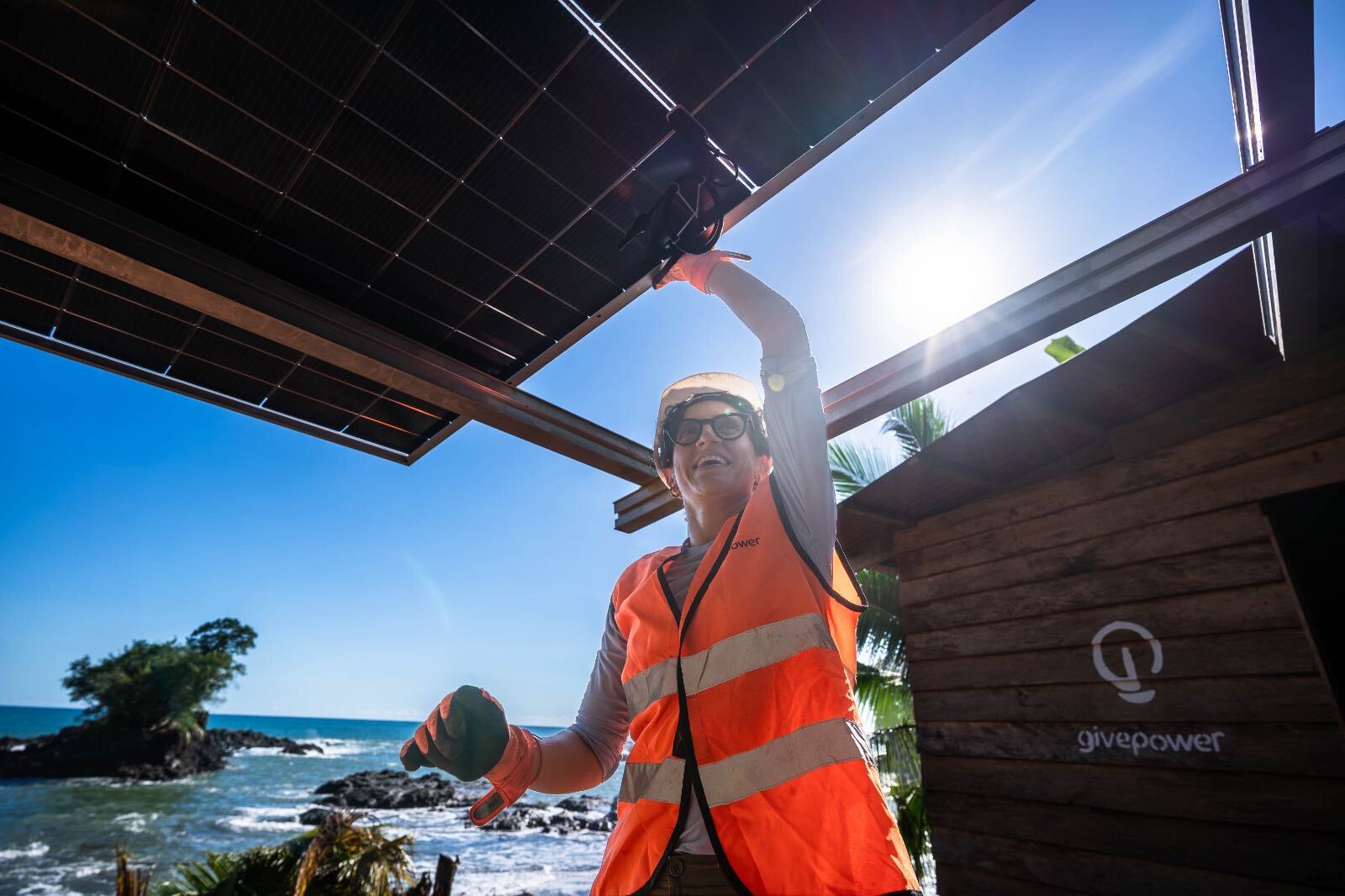
We spent four intense days cabling the site and installing a solar system for a community that has never had reliable power: eight panels, wired to bring light and outlets to the whole village. There was no phone signal, no way to check a message, just the sound of the waterfall and a stretch of beach you can only reach by boat,. A rainforest on one side, the Pacific on the other. It is an almost impossibly beautiful place, but it is also completely cut off. And that same isolation makes it much harder to get help when something like yesterday happens.
The solar system we installed will allow the community to refrigerate and sell food, provide electricity for visitors, and keep basic communications running through satellite internet. The community also hopes to open its doors to ecotourism and strengthen local livelihoods, while maintaining high standards of conservation and protecting the ecosystem it depends on.
GivePower brings deep experience delivering solar solutions in remote communities, particularly for eco-tourism and conservation, health and education projects. It has built strong partnerships that help make this kind of work possible. Alongside GivePower’s work bringing electrification to these communities, we believe Global Energy Alliance can bring the experience we have built through Powering Opportunity, helping communities use reliable energy to strengthen local livelihoods and, over time, translating those lessons into approaches that can inform public electrification policy across Colombia.
After yesterday’s earthquake, and once I knew my family was safe, one of the first things I wanted to know was whether everyone in El Tigre was okay. We were able to reach the community, and thankfully they are all safe. Many other families have not been as fortunate.
That made the connection to our work feel particularly real. Just over a week ago, this community had no reliable power and very limited ways to communicate with the outside world. Today, having energy and a way to stay connected meant that we could reach them and know they were safe. Reliable energy cannot prevent a disaster like this, but in remote communities it can make a very real difference when one happens.
Right now, the priority is supporting the families and communities affected by the earthquake and the emergency response underway. But this is also a painful reminder of how much basic infrastructure matters in places like Chocó, especially when distance and isolation can so quickly become a barrier to getting information, reaching people and getting help where it is needed.
To support the emergency effort in Chocó, please give to Fundación Tierra Grata or the Colombian Red Cross.


Explore More
-
 The human side of clean energy transition: technologies…The human side of clean energy transition: technologies…Blog28.10.2025Asia
 -
 Global Energy Alliance shows how partnership powers energy…Global Energy Alliance shows how partnership powers energy…Press Release22.09.2025Global
 -
 What Africa’s largest hydro-solar-powered mini grid can teach…What Africa’s largest hydro-solar-powered mini grid can teach…Blog29.07.2025AfricaDemocratic Republic of the Congo