Global Energy Alliance Systemic Impact Framework

Global Energy Alliance is committed to achieving ambitious global goals. By 2030, the Alliance aims to avoid 4 Gigatons of carbon emissions going into the atmosphere, electrifying 1 billion people, and enabling 150 million sustainable livelihoods. If accomplished, these targets could transform the energy landscape in over 20 countries, touching millions of people and creating the conditions to enable thriving clean energy markets worldwide.
The global projected investment requirement for climate action is around $6.3–6.7 trillion per year by 2030, of which $2.3–2.5 trillion needs to be deployed in EMDCs other than China.[1] Viewed from this context, the projects Global Energy Alliance is funding are but a drop in the ocean of the financing required to end energy poverty. But when taking into consideration the interconnectedness of interventions undertaken across the Alliance, we posit our collective contributions could be much larger.
Indeed, the Alliance was created to orchestrate the multiple complementary and integrated interventions by networks of partners required to accelerate the energy transition globally. So, while in the past three years, we have relied on a robust monitoring system and impact estimation methodology to assess the performance of our direct projects in delivering Carbon, Access and Jobs (CAJ), we are now expanding our field of measurement to look at the broader impact of our interventions and their potential to reach tipping points and unlock new investments in clean energy.
Global Energy Alliance delivery of CAJ is achieved through two pathways: (1) through direct investments or essential project development for a specific transaction, leading to ‘portfolio CAJ impacts’; or (2) through projects and activities that catalyze additional clean energy investments by others in the ecosystem, leading to ‘systemic CAJ impacts.’ Global Energy Alliance proprietary Systemic Impact Framework is designed to help us better understand the latter, systemic impacts that result from the aggregation of efforts across the clean energy ecosystem. This framework provides the tools to assess how the sum of many interventions, including key alliancing initiatives, contributes to driving systemic change and fostering sustainable investments.
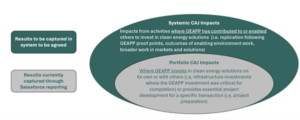
Measuring systemic impact goes to the root of Global Energy Alliance mission of catalyzing transformative change, which is notoriously difficult to measure not only due to the challenges of capturing impact metrics, but also tracing the relationships between interventions as well as the actors in that ecosystem. , Global Energy Alliance is adopting an innovative and rigorous method of Contribution Analysis and making refinements to the MEL system to integrate systemic impact, provide actionable insights, and investigate alignment with Global Energy Alliance Theory of Change.
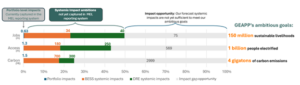
Our approach to systemic impact is based on Contribution Analysis, a robust methodology widely used in MEL by governments and development agencies.[1] This theory-based approach is ideal for complex situations where multiple factors drive outcomes. Contribution Analysis doesn’t aim to directly attribute an outcome to a single intervention. Instead, it builds a “contribution story” by examining evidence, assumptions, and alternative explanations to assess the plausibility of the intervention’s role in achieving the results.
The goal isn’t to take full credit for the impact, but to better understand how our interventions interact with the system to tell the story of how (or how not) our investments are helping the alliance and wider sector progress toward our shared goals. Contribution Analysis allows us to claim a contribution to impact, showing that our work is a necessary part of a broader web of factors that led to change. This will be demonstrated through a market-level theory of change and tested by a peer-reviewed panel. A refreshed set of indicators will inform and validate these contribution claims in three levels: outcome, scaling outcome, and Systemic CAJ. These are aligned with and build upon existing Global Energy Alliance indicators and systems, ensuring they remain compatible with current analysis and reporting processes.
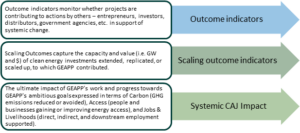
A collaborative approach to measurement
Contribution claims will be developed for specific country-markets (e.g., DRE in Nigeria) and supported by evidence that clean energy, measured in GW capacity and/or $ invested, has been delivered, with Global Energy Alliance interventions playing a role in this delivery. These claims will be tested and verified through Contribution Assemblies, which are collaborative workshops involving Global Energy Alliance and partners.
The Assemblies assess the contribution claims and also offer a platform to surface and elevate insights on how the Alliance can contribute to Systemic Impact. The CAJ impact will be modeled using Global Energy Alliance Global Solutions Model.
We are excited to begin using this approach more systematically, with promising results emerging from our work in Nigeria’s DRE ecosystem, to be reported fully in mid-2025. Additional pilots are in the pipeline, expanding our reach and refining our methods. Systemic Impact data will begin flowing into the Alliance Impact dashboard, providing critical insights that will help shape our collective strategy moving forward.
Systemic Impact is the reason we exist, and we are confident that these efforts will not only drive the scale of clean energy deployment but also catalyze broader, lasting change across markets. The road ahead is challenging, but through continued collaboration and rigorous assessment, we are poised to make meaningful progress toward a cleaner, more sustainable future together
Explore More
-
 Global Energy Alliance shows how partnership powers energy…Global Energy Alliance shows how partnership powers energy…Press Release22.09.2025Global
 -
 Global Energy Alliance for People and Planet (Global…Global Energy Alliance for People and Planet (Global…Press Release24.01.2025Global
 -
 Ministry of Energy of Brazil and Global Energy…Ministry of Energy of Brazil and Global Energy…Press Release22.11.2024BrazilLatin America & Caribbean