London was cooking: Five takeaways from London Climate Action Week 2026

From extreme heat and energy security to AI, electrification and a sharper focus on delivery, here is what stood out at the largest London Climate Action Week yet.
There could hardly have been a more fitting, or uncomfortable, backdrop for London Climate Action Week.
As tens of thousands of people crossed the city to discuss climate change, London sweltered through record-breaking June heat. Schools closed early, employers advised people to work remotely and a planned discussion on improving the global response to extreme heat was cancelled because its venue was too hot.
As UN Secretary-General António Guterres put it: “London isn’t just calling. It’s cooking.”
Elsewhere, the show went on. Financiers sweated through sharp suits. The more sensibly dressed moved around the city in linen or on the free Santander bikes. Across 1,300 events, more than 75,000 participants discussed everything from electricity grids and artificial intelligence to food systems, oceans and climate finance.
Amid all that activity, five themes stood out.
-
Climate impacts entered the room
Climate conferences often involve people sitting in comfortable venues discussing impacts being experienced somewhere else.
London offered little distance this year.
The heat followed participants into offices, onto public transport and through the streets. It disrupted events and showed how poorly even a wealthy global city is prepared for temperatures that are becoming more frequent and intense.
At an EY event, Agnes Dasewicz of Global Energy Alliance for People and Planet described what infrastructure failure feels like in daily life. Workers feel it when they cannot sleep because of the heat or afford a fan. Farmers feel it when crops spoil before reaching market because refrigeration is unavailable. Businesses feel it when unreliable electricity limits production and growth.
Climate resilience determines whether buildings remain habitable, transport functions, food reaches market and electricity continues to flow when demand surges.
The week’s weather made that case more forcefully than any slide presentation could.
-
Energy security moved to the center of the transition
Energy security, affordability and economic resilience shaped much of this year’s discussion. Conflict and geopolitical instability have again exposed the risks of relying on volatile fossil-fuel markets and vulnerable supply routes.
One speaker captured the shift neatly: renewable energy is often called unreliable, yet none of it has to travel through the Strait of Hormuz.
Guterres made a similar argument, presenting fossil-fuel dependence as a driver of both the climate crisis and today’s energy shocks. Clean power and grids are increasingly seen as strategic infrastructure, central to national resilience and economic competitiveness.
That helped put electrification near the top of the agenda.
At the Global Energy Transition and Electrification Summit, governments, companies and international partners launched Electrify Now, a platform focused on electrifying transport, buildings and industry while strengthening grids, storage and supply chains.
But enthusiasm for electrification quickly runs into a physical constraint: the grid.
The technology to generate clean power is advancing rapidly, and capital is available for viable opportunities. Power networks have not kept pace. As one participant put it, the issue is not the technology or the capital. It is the grid.
Without stronger, smarter and more flexible power systems, renewable generation can sit waiting while consumers and businesses continue to face unreliable or expensive electricity.
-
The most interesting conversations were about getting things done
Climate weeks are rarely short of announcements. Many of this year’s most useful discussions focused instead on the difficult work between setting a goal and delivering it.
Why do viable projects struggle to reach financial close? What support do developers need before investors can participate? How can domestic capital play a larger role? Where are organizations duplicating one another’s work while other needs go unmet?
These questions shaped a roundtable convened by InfraCredit and Global Energy Alliance. Around 30 investors, development finance institutions and energy leaders examined the barriers holding back distributed renewable-energy projects in Nigeria.
InfraCredit’s Distributed Renewable Energy Enhancement Facility brings together project preparation, developer support, productive energy use and local-currency financing. Global Energy Alliance has committed $1 million to help launch its start-up phase.
A related coordination challenge surfaced at a workshop hosted by Global Energy Alliance and Systemiq. More than 35 organizations tested an early version of the Global Initiatives Atlas, an open-access map of programs working across energy access, grids and the energy transition.
Participants discussed integrating existing datasets, adding hundreds of innovators and keeping the platform current. The session showed how much activity is already underway, but also how difficult it can be to see where efforts overlap, where gaps remain and which models are ready to scale.
A clearer view of the landscape could help good ideas and investment travel faster.
-
Electricity matters most when people can use it
Reliable electricity can keep food cold, power machinery, irrigate fields, support healthcare and allow businesses to grow. Yet energy access and economic development are still often addressed through separate institutions and funding streams.
Several discussions showed the value of bringing them together.
In Kenya, solar-powered cold storage is helping avocado farmers preserve more of their harvest. In India, clean-powered agricultural equipment is helping women process more produce and increase their incomes.
The people using these systems may never describe them as climate projects. They see a harvest that no longer spoils, an easier working day or an income that goes further.
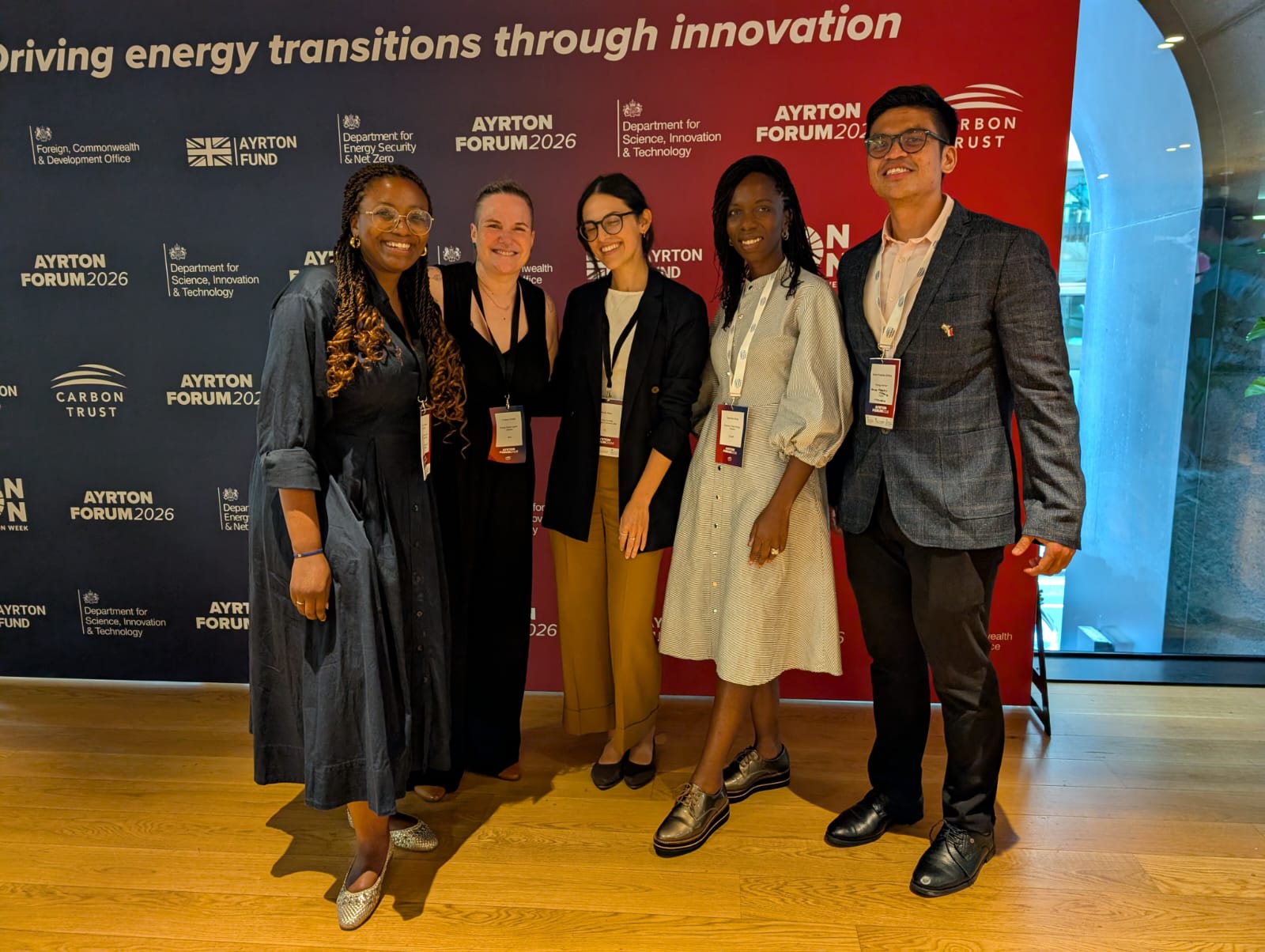
That human connection also emerged at Devex Impact House, where Global Energy Alliance’s Nchimunya Erlank-Hamukoma joined former NBA player Pops Mensah-Bonsu and entrepreneur Ryan Kohn to discuss the new partners and messengers climate action needs. Their different experiences led to a shared conclusion: solutions gain support when they connect with people’s lives and when institutions work beyond their usual circles.
This is the thinking behind Powering Opportunity. Expanding electricity supply is only one part of the challenge. People and businesses also need equipment, finance and market connections to turn that power into better livelihoods and stronger local economies.
The transition becomes more tangible when measured in crops saved, businesses grown and incomes increased.
-
AI is adding pressure to grids while helping improve them
Artificial intelligence appeared everywhere during the week.
The data centers supporting AI consume large amounts of electricity and water, adding pressure to grids already struggling to meet demand. AI can also help electricity systems forecast that demand, detect losses, manage assets and integrate more renewable energy.
Guterres used his London address to propose an AI Environmental Transparency Initiative, calling on companies to disclose the carbon, water and land impacts of their systems and commit to powering data centers with renewable energy by 2030.
At the Climate Innovation Forum’s AI Solutions Showcase, Global Energy Alliance’s Umang Maheshwari discussed how AI-enabled digitization can improve poorly mapped and loss-making distribution networks. Better data can help utilities understand their assets, anticipate demand, reduce losses and connect more renewable power.
This is especially valuable in emerging economies, where electricity use is rising rapidly but utilities may lack reliable information about their networks.
The task now is to make AI’s overall contribution positive: cleaner data centers, greater transparency and deliberate investment in applications that strengthen the systems people depend on.
Cooperation gets practical
The theme running through the E3G-led week was “cooperation in a fractured world.”
On the ground, that felt less like a slogan and more like a description of how climate action is evolving. Emerging economies had a stronger presence. Businesses discussed what they need to electrify. Investors worked through the obstacles preventing projects from moving. Organizations explored how to combine data and expertise.
The focus was often specific: modernize this grid, prepare this project, help these farmers, map this activity.
Progress does not always begin with a sweeping agreement. Sometimes it begins with 30 people in a room working through why a project is stuck and who can help move it.
That is why gatherings convened by E3G, Climate Action, Devex, Goals House and many others matter. They create space for institutions and people who may not usually work together to find common ground and begin building.
London Climate Action Week offered plenty of big ideas. Its most hopeful message was simpler: cooperation remains possible when it is organized around problems people urgently need to solve.
Explore More
-
 5 Takeaways: What We Learned at the Africa…5 Takeaways: What We Learned at the Africa…Blog29.06.2026Africa
 -
 Rockefeller Foundation, Global Energy Alliance, Clean Cooking Alliance,…Rockefeller Foundation, Global Energy Alliance, Clean Cooking Alliance,…Press Release18.02.2026Africa
 -
 5 takeaways: what we learned at London Climate…5 takeaways: what we learned at London Climate…Blog01.07.2025Global